

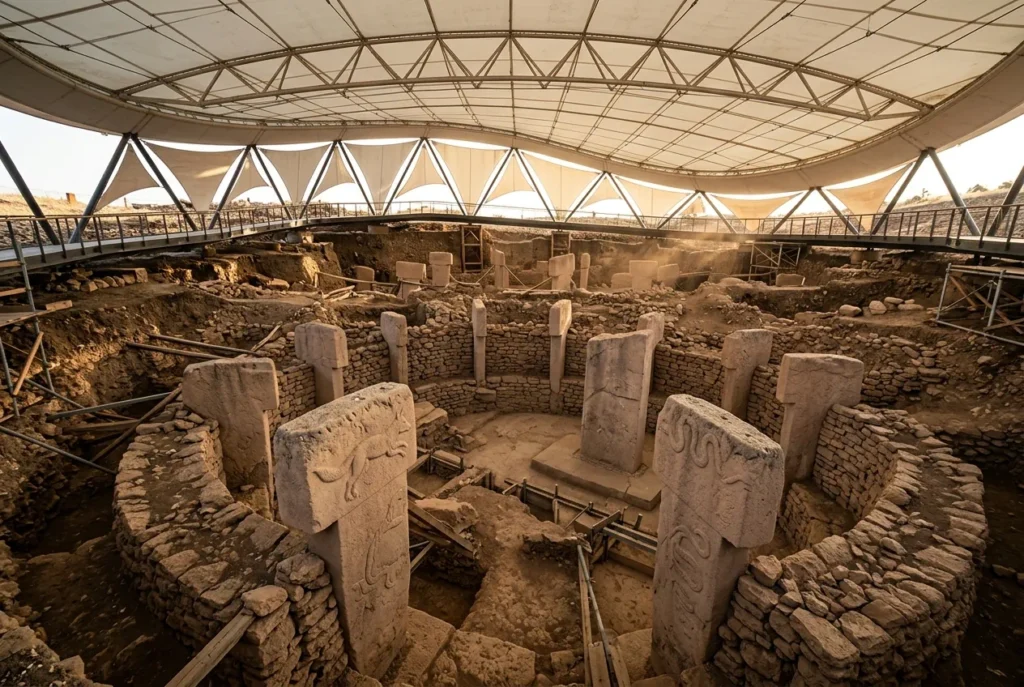
What Göbeklitepe actually is
Göbeklitepe is a hilltop in southeastern Turkey, 15 kilometres northeast of Şanlıurfa, where Neolithic hunters raised a series of circular stone enclosures out of massive T-shaped limestone pillars. The largest pillars stand 5.5 metres tall and weigh up to 16 tonnes. They were quarried nearby, dragged to the hill, carved with animals, and set into sockets cut into the bedrock floor.
Then, somewhere around 8000 BCE, the whole complex was deliberately buried under rubble and soil.
It stayed buried for ten thousand years. That is the fact that makes Göbeklitepe more than an archaeological curiosity: it was not abandoned and silted over by accident. It was filled in, on purpose, by the people who built it.
The date, and why it matters
The enclosures are dated to roughly 9600–8200 BCE — the Pre-Pottery Neolithic. That places them roughly 7,000 years before the Parthenon, 6,000 before Stonehenge, and about 1,000 before the earliest evidence of farming in this region.
The standard account of prehistory runs in a sequence: people settle, they farm, agriculture produces surplus, surplus allows specialisation, specialisation allows monumental architecture and organised religion. Göbeklitepe inverts the order. Here is monumental architecture, carved by people who were not yet farmers, built before the first fields.
That inversion is what the phrase “rewrote prehistory” refers to. It is not that Göbeklitepe is the oldest building in the world — older structures exist. It is that organised, large-scale ritual construction appears to have come before agriculture, not after. The conventional cause-and-effect was the wrong way round.
Some archaeologists go further and argue that the need to gather and worship is what drove people to settle and eventually farm. That remains a contested reading rather than settled fact, and academic opinion is not unanimous. What is no longer disputed is that the complexity at Göbeklitepe was not supposed to exist at that date.
The pillars and what is carved on them
Each enclosure, called a “temple” in popular writing and an enclosure in the literature, has a pair of central T-shaped pillars facing each other, with a ring of smaller pillars around the perimeter.
The T-shape is read as a stylised human figure: the horizontal top is the head and shoulders, the vertical shaft the body. Several of the pillars have arms and hands carved at the sides, and the belt-and-loincloth motifs that identify them as people.
The reliefs on the pillars are what most visitors remember. Across the site there are foxes, snakes, aurochs, cranes, wild boar, scorpions, lions and spiders, carved in high relief into the limestone. Enclosure D’s central pillars are the best preserved.
The most discussed carving — on Pillar 43, often called the Vulture Stone — shows a vulture with a human head beneath it, surrounded by other animals. It has been interpreted as a burial scene, a sky map, a calendar, and a warning. None of these readings is conclusive. It is worth knowing that before you read a guidebook claim.
What has not been found
No houses. No hearths in domestic arrangement. No evidence of a resident population. Very few tools in the enclosures themselves. The site appears to be somewhere people came to, for a purpose, and then left.
Water is another puzzle. The hill has no spring. The nearest water source is several kilometres away, which means the labour force that built and used Göbeklitepe was carrying or hauling its water.
Who found it, and who buried it
The site was first recorded in a 1963 survey, when archaeologists noted broken limestone slabs and dismissed them as a Byzantine cemetery. Excavation began in 1995 under Klaus Schmidt of the German Archaeological Institute, and continued under Turkish direction after his death in 2014.
Göbeklitepe was inscribed as a UNESCO World Heritage Site in 2018. A protective steel roof now spans the excavated area — necessary for conservation, and slightly at odds with the photographs everyone has seen, which were taken before it went up.
Excavation continues. Only a fraction of the hill’s enclosures has been opened, and geophysical survey suggests more remain untouched.
Karahantepe and the wider picture
Göbeklitepe is not alone. Excavations at Karahantepe, 60 kilometres to the east, have uncovered a similar complex of T-shaped pillars and a large rock-cut cistern complex. Similar sites — Harbetsuvan, Taşlıtepe, Sefertepe — are known across the Şanlıurfa region.
The emerging picture is not a single temple but a network: several communities in the same region, in the same period, building in the same idiom. Göbeklitepe is the best known because it was found first, not because it was unique.
Visiting
Göbeklitepe is 15 kilometres from central Şanlıurfa, about 25 minutes by road. The site is open daily; the visitor centre and the wooden walkway loop take around 90 minutes in total.
The finds — including a life-size boar statue and the anthropomorphic pillars — are in the Şanlıurfa Archaeological Museum, which is the better half of the visit and should not be skipped. Budget two hours there.
Şanlıurfa itself has Balıklıgöl, the pool and cave associated with Abraham, the old bazaar, and Harran with its beehive houses and the remnants of the oldest Islamic university, all within a day of the site.
Most visitors do it as a long day from Istanbul by flight, or as a stop between Cappadocia and Mardin.
Frequently asked questions
How old is Göbeklitepe exactly? The main enclosures are dated to approximately 9600–8200 BCE, based on radiocarbon dating of organic material in the fill. It is roughly 11,600 years old at its earliest phase.
Is it really the world’s oldest temple? It is the oldest known monumental ritual complex of its kind. Older structures and older evidence of ritual exist elsewhere. What makes Göbeklitepe exceptional is its scale, its date, and the fact that it was built by people without agriculture.
Why was it buried? Unknown. It was deliberately backfilled around 8000 BCE and no consensus explanation exists. Working theories include ritual closure, protection from flooding, and the site losing its significance as the surrounding society changed.
Do I need a guide? Strongly recommended. There is almost no explanatory signage at the site itself, the carvings are weathered, and the force of the story depends on context the museum provides. A guide who can read the reliefs transforms a pile of stone pillars into something legible.
How long does a visit take? The site itself is about 90 minutes. With the Şanlıurfa museum, allow a full day from Istanbul.