

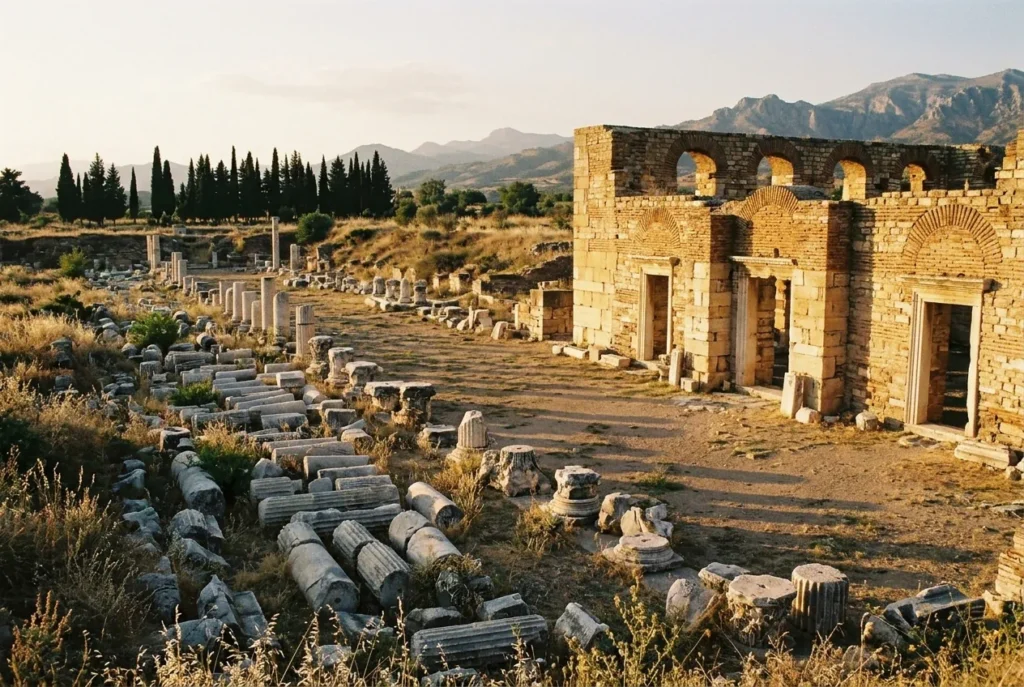
The seven churches addressed in the book of Revelation were seven real congregations in seven real cities, all in western Asia Minor — modern Turkey — and all within about 300 kilometres of each other. That compactness is the reason a route across all seven is possible at all, and it is why the geography still determines how a visit works today.
Here is what each site is now, what survives, and how they fit together.
The seven, in geographical order
| # | Ancient name | Modern name | What survives |
|---|---|---|---|
| 1 | Ephesus | Selçuk | The city itself — the most complete classical site in the region |
| 2 | Smyrna | İzmir | The agora, and a living city of 4 million |
| 3 | Pergamon | Bergama | The acropolis, the steepest theatre in the ancient world, the Asklepion |
| 4 | Thyatira | Akhisar | Very little — a few foundations in a modern town |
| 5 | Sardis | Sart | The synagogue and gymnasium, the largest known synagogue of antiquity |
| 6 | Philadelphia | Alaşehir | A few columns in a town square |
| 7 | Laodicea | near Denizli | A large excavated site with a restored theatre and colonnade |
Ephesus
The first of the seven and the one that needs no introduction. Ephesus was a port city of a quarter of a million people, and the letter to it — the longest of the seven — addresses a wealthy, established congregation in a city dominated by the Temple of Artemis, one of the Seven Wonders.
What to see: the Library of Celsus, the Great Theatre, the Terrace Houses, and the Basilica of St John on the hill above Selçuk, built by Justinian over what tradition holds is John’s burial site.
Time needed: three to four hours for Ephesus, plus an hour for the basilica.
Smyrna (İzmir)
The only one of the seven cities that is still a major metropolis. Smyrna’s letter is one of the two with no rebuke — it is addressed to a congregation under pressure and told to remain faithful.
What survives: the agora, a reconstructed colonnade and basement complex in the middle of the modern bazaar district, and the Church of St Polycarp, a 17th-century building on the site associated with the city’s bishop, martyred around 155 CE.
Time needed: two hours, including the agora and the church.
This is the one site where the contrast is the point — you are standing in a Roman marketplace with a modern city of four million people around it, which is exactly what Smyrna has always been.
Pergamon (Bergama)
Pergamon was not a New Testament city so much as a royal capital that became one — the Attalid kings built a library second only to Alexandria’s, and the acropolis sits on a cone 300 metres above the plain with a theatre of 10,000 seats cut into the steepest possible slope.
What to see: the acropolis (the altar of Zeus is in Berlin; what remains is the theatre, the Temple of Trajan and the library foundations), and the Asklepion below — a healing sanctuary where patients were treated with water, dreams and theatre, and which is arguably the ancestor of the modern hospital.
Time needed: three hours for both, plus the cable car.
Thyatira (Akhisar)
The longest of the seven letters, addressed to a congregation criticised for tolerating false teaching. Almost nothing survives. There is a small excavated area in the town centre with a few foundations and columns.
Time needed: 30 minutes. It matters for completeness rather than for what you see, and any honest route will tell you so.
Sardis (Sart)
The most rewarding of the lesser-known four. Sardis was the capital of Lydia — the kingdom of Croesus, and possibly the place coins were invented. The letter to Sardis is the harshest of the seven: “you have a reputation for being alive, but you are dead.”
What survives: a synagogue beside a gymnasium, forming the largest known synagogue complex from antiquity — a 120-metre hall with floor mosaics, marble benches and a Torah shrine still in place. It dates from the 3rd century CE, later than Revelation, but it is the single best surviving illustration of diaspora Jewish life in Asia Minor.
Time needed: 90 minutes.
Philadelphia (Alaşehir)
The church that received one of the two letters with no rebuke, commended for keeping its witness through the earthquake of 17 CE that destroyed the city. Little survives: a few Byzantine columns and foundations in a small park in the town centre.
Time needed: 30 minutes. Like Thyatira, this is a completeness stop.
Laodicea
The lukewarm church, and the letter that gave English the phrase “lukewarm.” Laodicea was a wealthy banking city with a famous medical school and a textile trade, and it was destroyed by earthquake in 60 CE and rebuilt without imperial help — which the letter uses as an image of self-sufficiency.
What to see: a very large excavated site with a restored theatre, a colonnaded street, two theatres and a stadium, with active excavation ongoing. It is the most impressive of the lesser-known sites by a wide margin.
Time needed: two hours. It is 20 minutes from Pamukkale, so it pairs naturally with Hierapolis.
Why the order matters
The seven sit on a rough north-south axis along the Aegean hinterland, and any efficient route runs **Smyrna → Pergamon → Thyatira → Sardis → Philadelphia →