

Gallipoli: what to see and when to go
Gallipoli is a peninsula in European Turkey at the mouth of the Dardanelles, roughly 340 kilometres from Istanbul. For most visitors it is a place with a landscape and a story, both of which need explaining. For Australians and New Zealanders it is something closer to a pilgrimage, and the site is organised accordingly.
This is what is there, how to reach it, and how the calendar affects a visit.
What happened, briefly
The Gallipoli campaign ran from the naval attempt to force the Dardanelles in March 1915, through the amphibious landings on 25 April, to the evacuation in December 1915 and January 1916.
The Allied objective was to knock the Ottoman Empire out of the war and open a supply route to Russia. It failed. Both sides dug in on a narrow peninsula for eight months. The total dead on all sides is usually estimated at around 130,000, with several hundred thousand wounded.
The Australian and New Zealand contingent — ANZAC — landed north of the main British landing at Cape Helles, on a stretch of coast that became Anzac Cove. The campaign is regarded in Australia as the moment a national identity was formed, and it is still marked every year on 25 April.
Getting there
From Istanbul: 340 km, four and a half to five hours each way by road, including a short ferry crossing of the Dardanelles or a longer drive around the Gulf of Saros. A single-day private tour runs 14 to 17 hours door to door. It is a long day and people underestimate it.
From Çanakkale: 40 minutes to the southern sites.
By air: the nearest airports are Çanakkale (on the Asian side, requiring a ferry crossing) and Tekirdağ or Istanbul, both involving road transfers.
Overnight is the better option. Staying in Çanakkale or Eceabat turns a punishing day into a calm day and a half, and puts you at the sites before the Istanbul coaches arrive.
The sites, south to north
Cape Helles at the tip of the peninsula holds the Helles Memorial and the British and French landing sites.
Morto Bay has the Çanakkale Martyrs’ Memorial, the large Turkish monument visible from the water, commemorating the Ottoman defenders.
Kabatepe has the Gallipoli Museum, small but well organised, and the closest thing to an orientation point.
Anzac Cove is the landing beach itself — a narrow strip of sand beneath steep cliffs, which is the single most useful thing to see if you want to understand why the landing stalled.
Shrapnel Valley and Shell Green are the ravines and plateau behind the cove where the ANZAC line held.
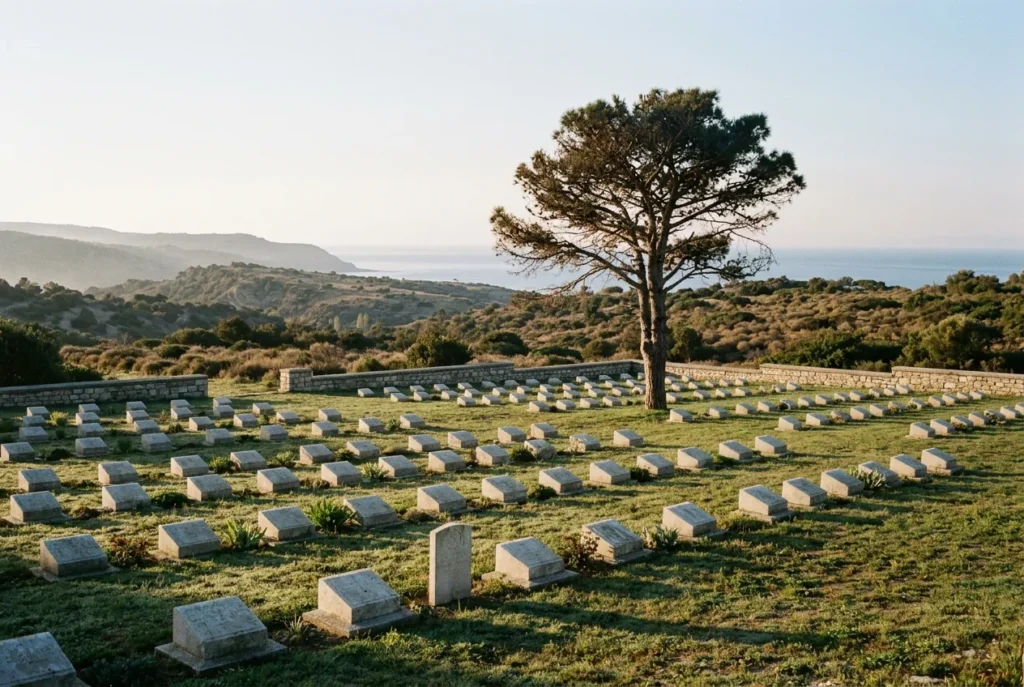
Lone Pine is the Australian memorial, on the site of the August 1915 battle, with the cemetery and the rows of headstones that appear in every photograph. The single pine on the ridge is a descendant of the original.
The Nek is the small plateau immortalised in Australian memory. It is a few dozen metres across, which is the point — a few dozen metres of open ground.
Chunuk Bair is the New Zealand memorial, on the high point the ANZAC forces briefly took in August, and lost.
The 57th Regiment Memorial on the Turkish side honours the Ottoman regiment that held the line at the landings. Its commander, Mustafa Kemal — later Atatürk — famously told his men he was ordering them to die, and they did.
Atatürk’s 1934 words on the memorial are the reason many Turkish and Australian visitors come to the same place with the same intent: “You are now lying in the soil of a friendly country. Therefore rest in peace. There is no difference between the Johnnies and the Mehmets to us.”
Anzac Day, and the calendar trap
The annual dawn service at Anzac Cove takes place on 25 April. The site is prepared for tens of thousands of people, access is restricted, and the peninsula is effectively closed to normal touring around 24–25 April.
If you are not attending the service, avoid those dates entirely. A normal guided tour is not possible, the roads are managed, and accommodation in the region is booked out months in advance.
If you are attending, book accommodation eight to twelve months ahead and expect to spend the night on site before the dawn service.
The better months for a normal visit are April to June and September to October. In July and August the peninsula is hot and exposed with very little shade. In winter it is cold, windy and often wet.
What a well-run day tour covers
A private day from Istanbul should include:
- Hotel pickup around 06:00 and return by 21:00–23:00
- Vehicle and driver for the full day
- Licensed guide with specific knowledge of the campaign
- The ferry crossing
- Lunch
- All four main memorial areas: Anzac Cove, Lone Pine, the Nek, Chunuk Bair
- The 57th Regiment Memorial and the Turkish memorial
Ask whether the guide has studied the campaign specifically. Gallipoli is one of those sites where a generalist guide is noticeably less useful — the ground is a series of very small distances that change meaning entirely when their history is not explained.
Why the terrain is the lesson
The thing most visitors are unprepared for is scale. From Anzac Cove to the frontline at the top of the ridge is under a kilometre — but it rises about 100 vertical metres through near-vertical scrubby ground.
That is the whole campaign in one view: the aim was never to cross a continent, only to get up a hill that is a few hundred metres away, and it could not be done.
Frequently asked questions
Can Gallipoli be done as a day trip from Istanbul?
Yes, but it is a 14–17 hour day with about five hours in each direction on the road. It is much better as an overnight stay in Çanakkale or Eceabat.
How much does a private Gallipoli tour cost?
Indicative: from around €200–350 per person on a private basis for a small party, including vehicle, guide, ferry and lunch. Larger parties reduce the per-person price significantly because the vehicle cost is shared.
Is the Anzac Day service open to anyone?
Attendance is free but registration is usually required in advance, and numbers are capped. Book accommodation months ahead.
Can Australians find family graves?
Yes. The Commonwealth War Graves Commission records are complete and searchable, and graves at Lone Pine, Beach Cemetery and the other cemeteries are individually marked. Give a relative’s name to the guide in advance and the visit can be planned around the specific grave.
What should I wear?
Comfortable walking shoes — the terrain is rough and unsealed. Sun protection in summer, a windproof layer in spring and autumn. There is very little shade anywhere on the peninsula.