

Most guides describe the Turkish bath as a spa treatment. It is not. For four centuries the hammam was the neighbourhood’s washhouse, its hospital and its social club, and the sequence of a visit has not changed since: heat, scrub, rinse, rest.
That sequence is what makes the first visit confusing. Here is what happens, in order, and what to do at each stage.
The building
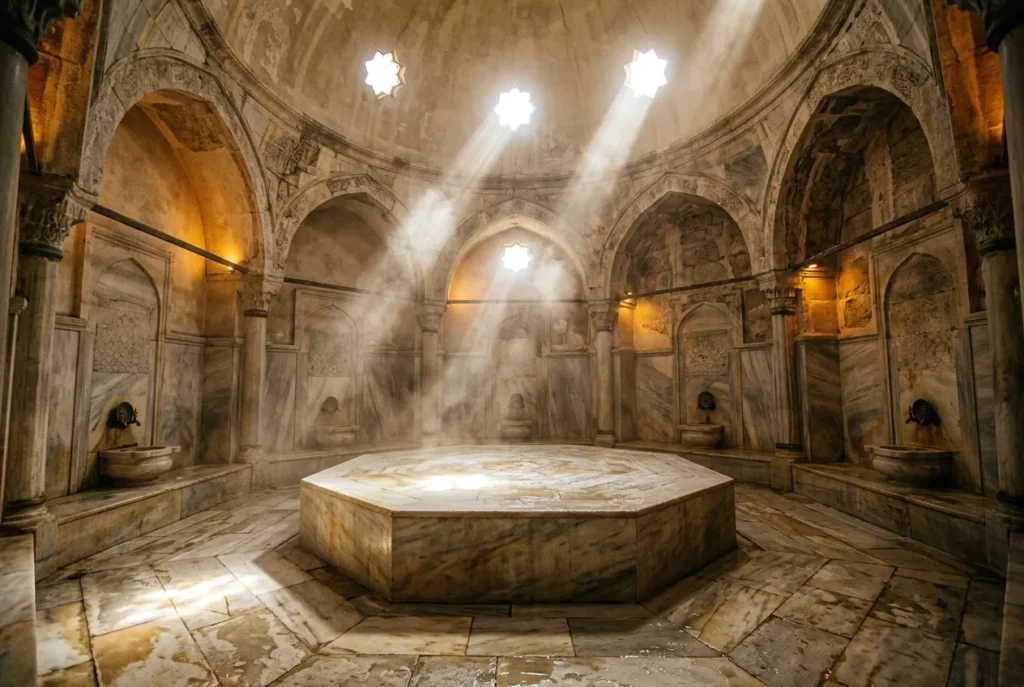
A traditional hammam has three rooms. The camekân is the changing room, usually with a high wooden gallery and lockers. The soğukluk is a cooler transition room with benches. The hararet is the hot room: a domed marble chamber with a large raised slab in the centre — the göbek taşı, “belly stone” — and small washing alcoves around the walls.
The dome is punctured with star-shaped glass openings. That is not decoration. The holes let light in and steam out, and they control the temperature of the room without any mechanical system.
The sequence
1. You are given a pestemal. A thin, striped cotton wrap, plus a towel and plastic slippers. You keep your underwear or swimsuit on under the pestemal. Change in the camekân, lock your belongings, and wrap the pestemal around yourself — chest to knee for men, chest to ankle for women.
2. You enter the hot room and sit. This is the part first-timers rush. Do not. Sit on the marble slab and do nothing for 10 to 15 minutes. Your body needs to open up before the scrub. The slab is heated from beneath and is genuinely hot.
3. The attendant scrubs you. You will be asked to lie on the slab. The attendant uses a kese — a rough mitt — and works systematically, and it is rougher than you expect. Grey rolls of dead skin come off. This is the point of the visit and it is not optional in a traditional hammam; if you want a gentle version, say so before the scrub starts.
4. The rinse. Buckets of warm water, poured over you. In older bathhouses this is done from a marble basin with a brass bowl; in restored ones it may be a shower.
5. The soap massage. Olive-oil soap worked into a foam, then a massage. This is the part that feels like a spa.
6. You rest. Back to the soğukluk, wrapped in towels, for tea or sherbet. Nobody expects you to leave immediately. Twenty minutes on a bench with tea is part of the ritual.
What to bring
Nothing. Towels, pestemal, slippers and lockers are provided at any bathhouse that takes visitors. Bring:
- A swimsuit only if you prefer to wear one under the wrap — many visitors do, especially in mixed-tourist bathhouses.
- Cash for gratuity — see below.
- Nothing valuable. Leave jewellery and phones in the hotel safe.
Do not bring your own towel. It is a mild faux pas and marks you as a first-timer.
Nudity and single-sex sections
Traditional Turkish bathhouses are single-sex, with separate sections or separate hours for men and women, and same-gender attendants throughout. This is the norm and it applies to almost every historic hammam.
Restored, tourist-facing bathhouses sometimes offer mixed sessions and private family rooms, usually at a supplement. If you are a couple who want to be together, book a private section explicitly — do not assume a mixed session exists.
Within a single-sex section, nudity is partial and unremarkable. You are wrapped. Nobody is looking. If you are uncomfortable, keep the swimsuit on; nobody will comment.
Tipping
Gratuity is expected and is the attendants’ main income. As a guide:
- Scrub and massage attendant: 10–15% of the entry price, in cash, handed directly at the end. In a €60 bath, that is €6–9.
- Changing-room attendant: a small note, €2–5, is appropriate if they have looked after your belongings and brought tea.
Put the cash in your locker before you start, so you are not fumbling wet-handed at the end.
Common mistakes
Rushing the heat. The scrub is ineffective if you have not steamed for long enough. Fifteen minutes minimum.
Refusing the kese. If you booked a traditional bath, the scrub is the point. A “massage only” visit is a different booking.
Wearing contact lenses. Take them out. The steam is intense.
Drinking before. Alcohol and a 45°C marble room do not combine. Eat something light an hour before instead.
Not saying you have a condition. Low blood pressure, heart conditions, pregnancy: tell the attendant. They will shorten the session or move you to a cooler room, and they do this routinely.
Photographing. Phones stay in the locker. Any bathhouse that permits photography inside the hot room is not a traditional one.
What it costs
Entry to a restored historic hammam in Istanbul runs €40–€90 depending on the building, with scrub and massage included or added. A neighbourhood bathhouse used by locals is a fraction of that, with fewer frills and no English — an option worth taking if you have a guide to make the booking.
Frequently asked questions
How long does a Turkish bath take?
Around 90 minutes: 15 minutes steaming, 20 for the scrub and massage, and the rest resting. Transfers add 15–30 minutes each way.
Is it suitable for children?
Over 12 usually fine. The heat is the constraint, not the etiquette.
Can women go alone?
Yes. Single-sex sections are the norm and women’s hours are well established at every historic bathhouse.
Should I tip, and how much? Y
Yes — 10–15% of the entry price to the attendant, in cash, plus a small note for the changing room.