

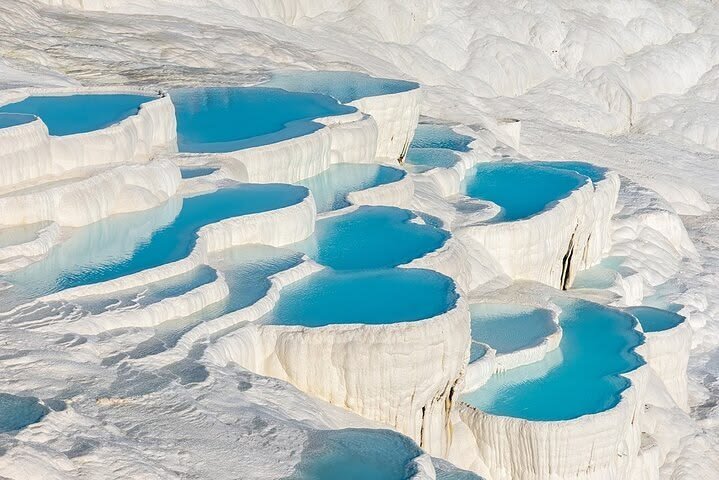
Nestled in the picturesque province of Denizli in southwestern Turkey, Pamukkale is a striking geological phenomenon that has captivated travelers for millennia. Translating literally to Cotton Castle in Turkish, the name perfectly describes the blindingly white, cascading mineral terraces that dominate the landscape. When combined with the incredibly preserved ruins of the ancient Roman spa city that sits directly above them, Pamukkale offers a travel experience that beautifully merges natural wonder with deep historical exploration. For those seeking relaxation and culture, a visit to these thermal pools is an essential addition to any luxury Turkish itinerary.
The creation of this unreal landscape is a testament to the power of nature. From a cliff rising almost 200 meters above the plain, naturally heated springs emerge, carrying waters heavily laden with calcium carbonate. As this thermal water flows down the hillside, it cools and deposits the minerals, creating a stunning series of petrified waterfalls, brilliant white stalactites, and step like terraced basins. Taking a dip in the Pamukkale thermal pools is a uniquely rejuvenating experience. The warm, mineral rich waters, reputed for their healing and therapeutic properties, provide a spectacular contrast against the bright white travertine and the sweeping, lush green views of the valley below.
The allure of these healing waters is not a modern discovery. At the end of the 2nd century BC, the Attalid kings of Pergamon established the thermal spa town of Hierapolis directly at the top of the terraces. The city was later ceded to Rome and flourished immensely during the 2nd and 3rd centuries AD. Today, the ruins of Hierapolis offer a fascinating exploration of Greco Roman life. A private guided walk through the site reveals immense ancient bathhouses, a monumental arch, and a remarkably well preserved theater dating back to the time of Emperor Severus, complete with intricate friezes depicting mythological scenes.
Hierapolis also holds immense religious significance. Following the Roman Empire’s acceptance of Christianity, the city became an important bishopric. It is the documented site of the martyrdom of Saint Philip the Apostle in 80 AD. Visitors can hike up to the Martyrium of Saint Philip, an impressive octagonal building accessed by a monumental stairway, which stands as an outstanding example of early Christian architecture. Additionally, the ancient city features a massive necropolis extending over two kilometers, offering a vast and sobering panorama of ancient funerary practices.
To protect this fragile UNESCO World Heritage site, visitors are now required to walk barefoot on the delicate white terraces, ensuring the calcium deposits remain pristine for future generations. The best time to visit is during the spring or autumn months when the climate is highly agreeable for exploring the exposed ruins of Hierapolis and the thermal pools are exceptionally comforting in the mild air. Taking the time to appreciate both the natural formations and the ancient architecture ensures a thoroughly enriching travel experience.
Experience the restorative powers of the ancient world for yourself. View our premium Pamukkale tours and secure your luxury booking today.